
📣 Sponsored by Bright Data. There’s a clearly-labeled sponsor section a few minutes in; everything else is my own independent take.
An open-source team rebuilt Anthropic’s most viral product of the spring, and the internet handed it 71,000 GitHub stars in eight weeks.
Every writeup leads with that number.
It is the least useful thing about the project.
Here is what is actually worth your time: what Open Design is, how the thing works, how it stacks up against Claude Design, and where the real business is hiding. Then you can decide for yourself whether the stars mean anything.
What Actually Shipped
Back up to April. Anthropic shipped Claude Design. In Open Design’s own framing, it was the first time an AI stopped writing about a design and started streaming the finished design itself. A landing page. A dashboard. A deck. The artifact, not advice about the artifact. It went viral.
It was also closed. Paid only. Cloud only. Locked to Anthropic’s model and Anthropic’s surface.
A studio called nexu rebuilt the same loop as open source and called it Open Design. Same mental model: brief in, finished artifact out. The difference is theirs runs on your own laptop, on whatever coding agent you already have, with your own model key.
That shift is real. AI is moving from answers to artifacts, and a local, no-lock-in version of that is something developers actually want. So let me show you how it works before I tell you why the star count is a trap.
How It Actually Works
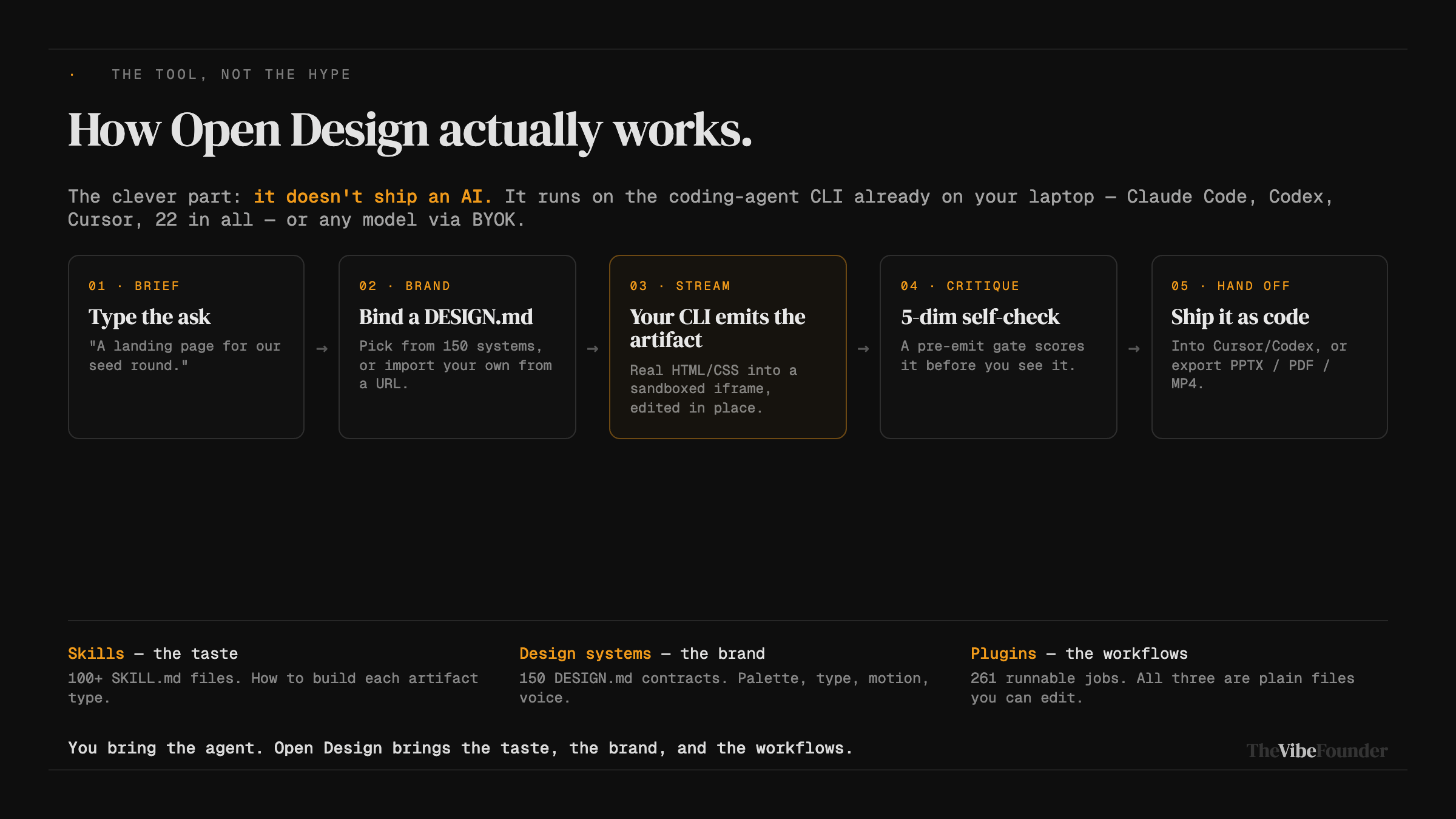
Open Design is built from three kinds of plain files. Once you see them, the whole thing clicks.
Skills are the agent’s design abilities. Each one is a SKILL.md file that teaches the agent how to do a single job: build a landing page, a dashboard, an onboarding flow, a pitch deck. Open Design ships more than 100 of them. They are just Markdown, so you can read, edit, copy, and version them.
Design systems are the brand rules. Each is a DESIGN.md file with a nine-section schema: color, typography, spacing, layout, components, motion, voice, brand, and anti-patterns. It is a contract that tells the agent what your product should look and feel like, and what it must never do. Open Design ships 150 of them, modeled on brands like Linear, Stripe, Vercel, Apple, and Anthropic itself.
Plugins are runnable workflows. Think prebuilt recipes: a Figma migration, a React export, a media generator, a full design scenario. 261 ship in the box.
Here is the cleverest decision in the whole project. Open Design does not ship an AI agent. It plugs into the one you already use. One command, od mcp install <agent>, wires it into Claude Code, Codex, Cursor, Copilot, Gemini, OpenClaw, Kimi, and around twenty others. It does this over MCP, the standard that lets an AI tool call other tools. So your agent reads the design systems, runs the skills, generates the artifact, and hands the work back, all without leaving the agent you already trust.
It is local-first. Native apps for macOS and Windows, a Linux build, Docker, or run it from source. And it is bring-your-own-key: point it at OpenAI, Anthropic, or Gemini, or at a local model through Ollama, LM Studio, or vLLM.
One best practice matters more than all the others. Without a design system, you get generic AI slop. Gradient hero, rounded cards, a fake dashboard, no taste. The DESIGN.md is the entire unlock. A blank prompt produces something that looks like every other AI landing page. A prompt plus a brand contract produces something directed.
⌁ SPONSORED · PAID FOR BY BRIGHT DATA
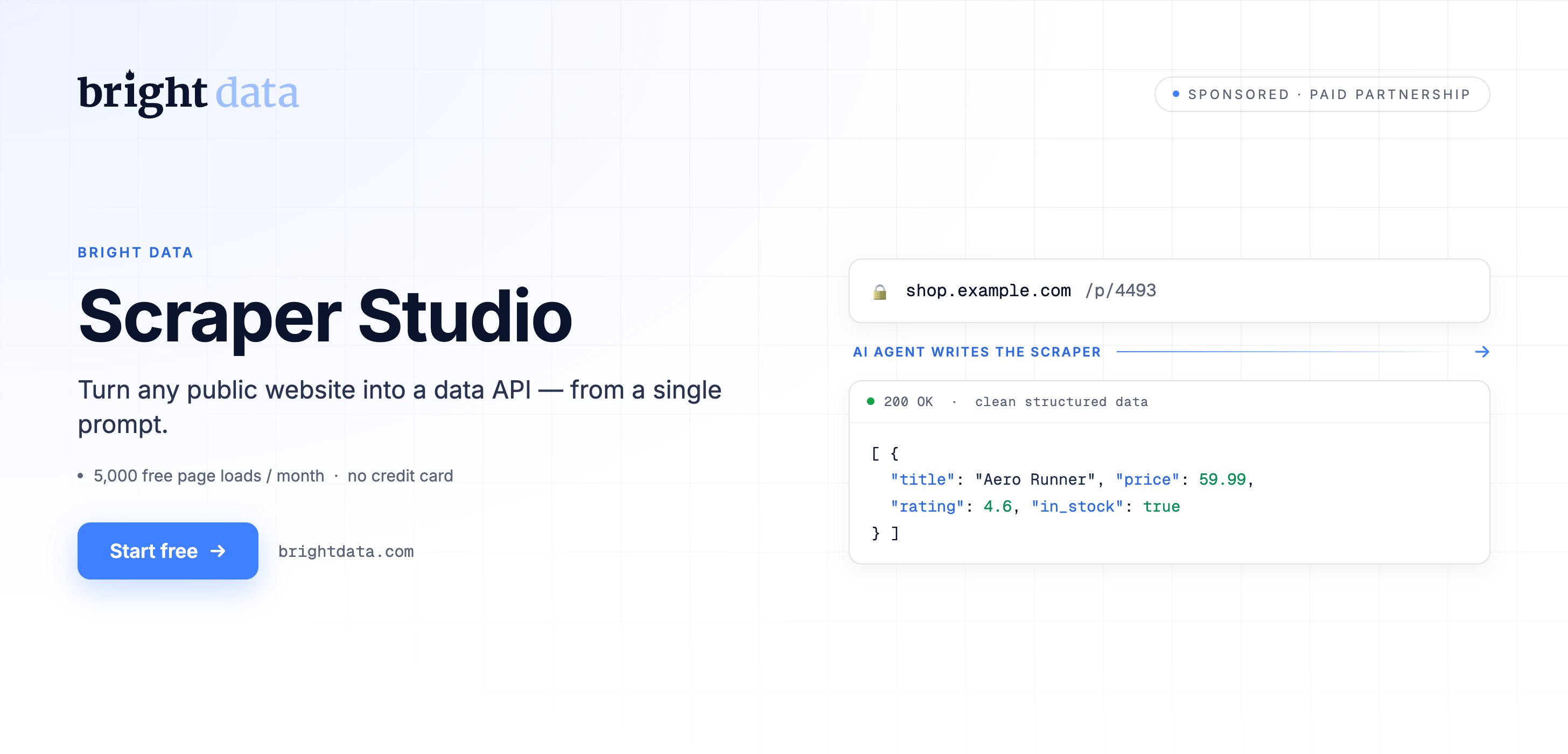
Open Design lets your agent generate artifacts. The other half of any real AI workflow is data — and current web data almost never arrives clean.
Bright Data Scraper Studio turns any public website into a structured data feed from a single prompt. Paste a URL, describe the fields you want, and its AI Agent writes the scraper. Same instinct as Open Design: you can build it straight from the Bright Data CLI inside Claude Code, Cursor, or Codex, and you own the generated code. Bright Data runs the proxies, browsers, and unblocking, so you skip the scraping stack. When a site changes and the scraper breaks, one-click Self-Healing repairs it. Every new Bright Data account gets 5,000 free page loads a month. No credit card.
Bright Data paid to sponsor this post. The rest of this article is my own independent take on Open Design.
What You Can Actually Make
The output is not a description of a design. It is the artifact, exportable.
Web, desktop, and mobile prototypes that come out as downloadable HTML. Live dashboards. Decks that export to PDF, PPTX, or Markdown. Images. And HyperFrames, which is animation code rendered to MP4, so the same brand system can produce a motion graphic.
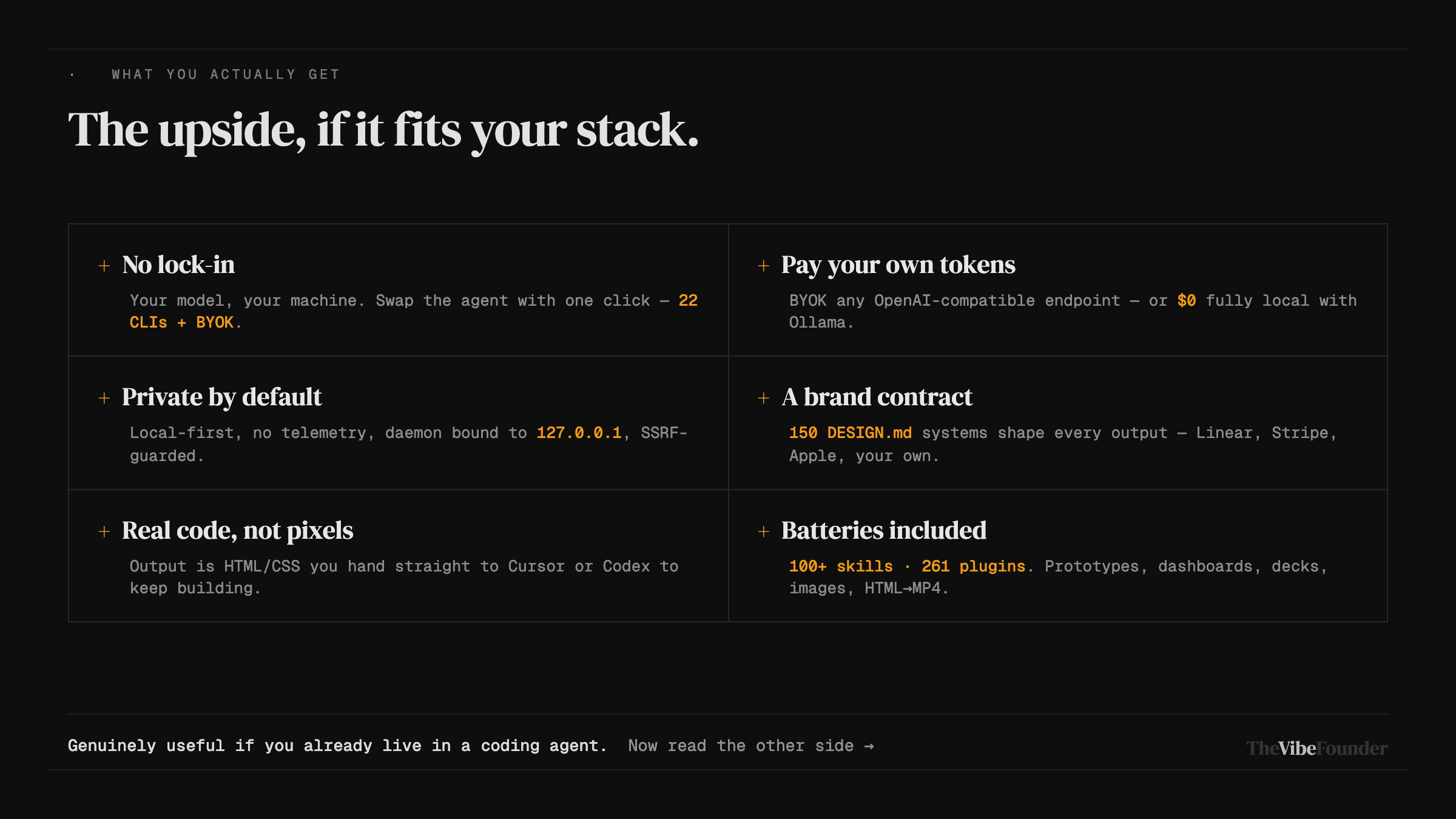
A real workflow looks like this. Write or extract a DESIGN.md for your product. Drop in a brief, your screenshots, and a competitor or two for reference. Generate the landing page. Comment on it, ask for changes. Export it. Hand the HTML to Codex or Claude Code to wire into your repo. Then generate the deck and the launch image from the same system, so everything matches.
That is the move worth stealing even if you never touch this tool. Build the brand contract once, generate everything against it. One-off prompts give you one-off assets. A design system gives you a brand operating system.
A few rules keep it from going sideways. Start with one artifact, not your whole brand, and prove the loop on a landing page first. Treat skills, design systems, and plugins as reusable files and keep them in git. And if you are designing around unreleased features or customer data, run a local model or your own key so none of it leaves your machine.
Open Design vs Claude Design
This is the comparison the whole project is built on, so be precise about it.
Claude Design proved the category. It is polished, it is hosted, and it is backed by a frontier lab. It is also closed source, cloud only, paid, and locked to Anthropic’s model and surface. You use it the way Anthropic built it.
Open Design takes the same loop and inverts every constraint:
Source: open versus closed. You can read it and change it.
Where it runs: your laptop or your own server versus Anthropic’s cloud.
Model: any model, including local ones, versus Claude only.
Cost: free to run with your own key versus a paid subscription.
Extensibility: skills, plugins, and design systems are files you author versus a fixed surface.
The honest read: Claude Design is the more finished product today. Open Design is the more flexible one, and the only one you fully control. It is also chasing Figma and the cloud app-builders like Lovable, v0, and Bolt, but the bet is different. Those are canvas tools or hosted app generators. Open Design wants to be the design layer your own agents drive, on your own machine.
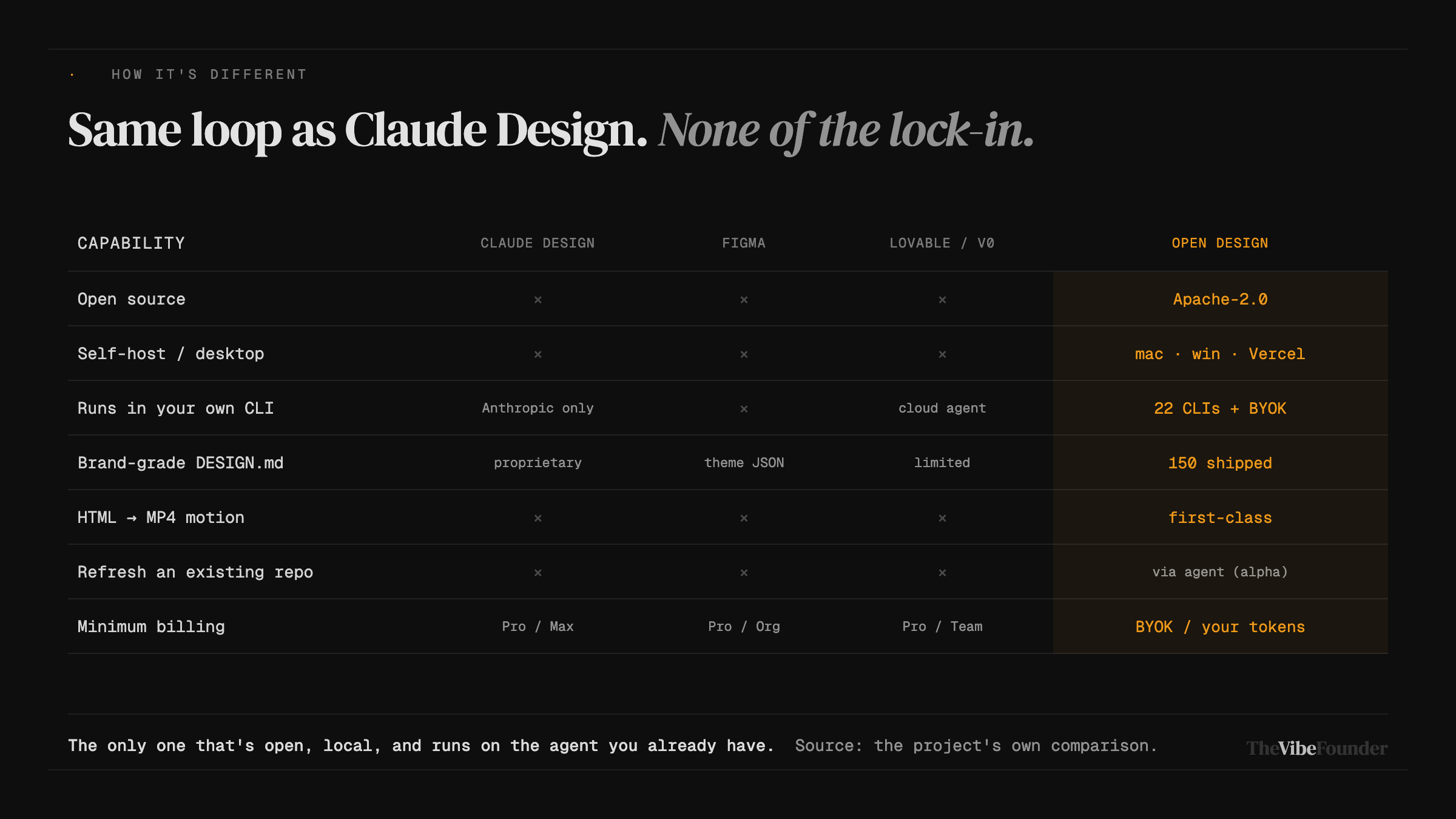
So who should actually reach for it? Builders and small teams who already live in a coding agent, want to own their stack, care about model choice or privacy, or want to package repeatable design work as plugins. If you want the most polished hosted experience and you are happy on Anthropic’s model, Claude Design is still the smoother ride.
Everyone’s Reading the Scoreboard Wrong
Now the part the coverage skips.
The star count is going to get read as a victory. The open version won. The clone beat the lab.
Stars do not mean that.
A GitHub star is one click from one person who liked a repo enough to bookmark it. It is attention. It is not a user, not a paying customer, and not proof the thing works.
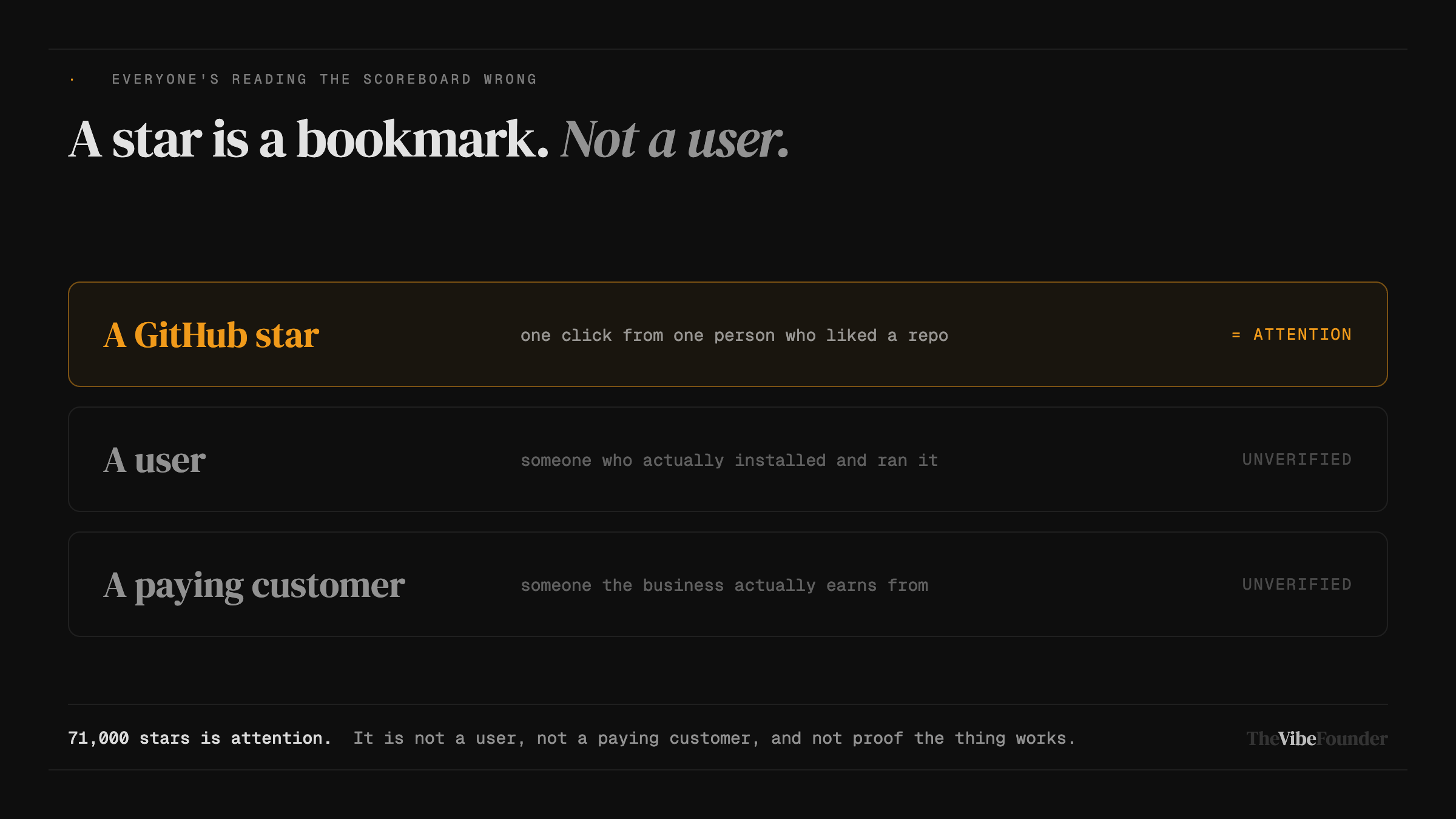
Attention happens to be the one thing this team is exceptional at manufacturing.
Look at how the repo is built. An account named cursoragent has committed code 116 times. That is an AI agent committing to the project. The parent org ships a public repo called auto-github-contributor. The README is translated into 13 languages for search reach. There is a “Fellow” program that pays contributors 1,000 dollars per merged request to grow the project in their region.
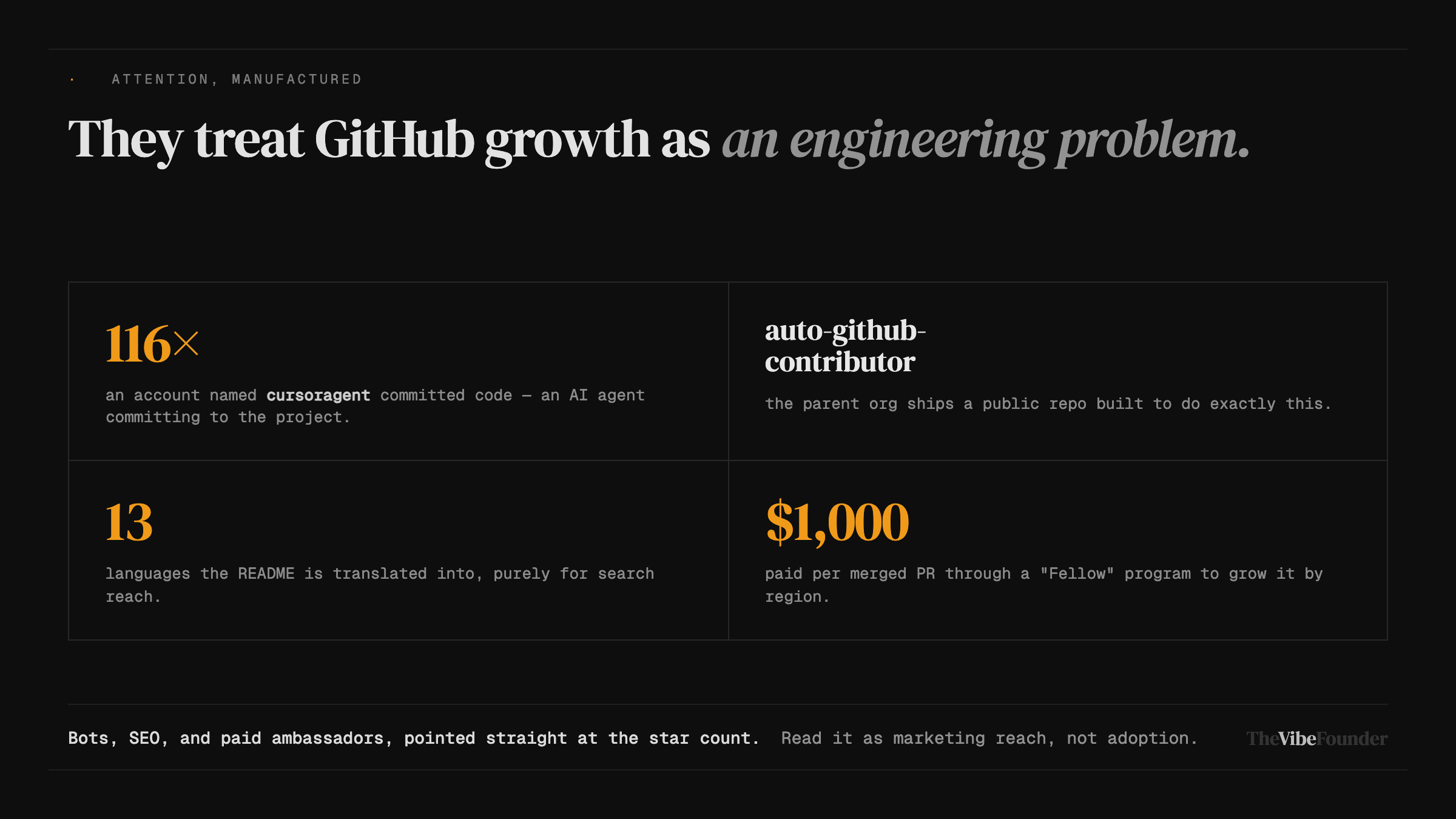
I cannot see the star-history curve, so I will not call the growth fake. But this is a team that treats GitHub growth as an engineering problem and points bots, SEO, and paid ambassadors straight at it. The 71,000 is partly a product of that machine. Read it as marketing reach, not adoption.
Follow the Model Router
Here is the number I would actually want.
The app is free. The business is not the app. It is a service called AMR, the Agentic Model Router. One recharge, and you get GPT, Claude, Gemini, and DeepSeek inside Open Design, billed by token usage.
That is the whole move. Give away the design tool. Sell the metered access to the models that power it. The open-source repo is not the product. It is the top of the funnel for a pay-per-token toll booth.
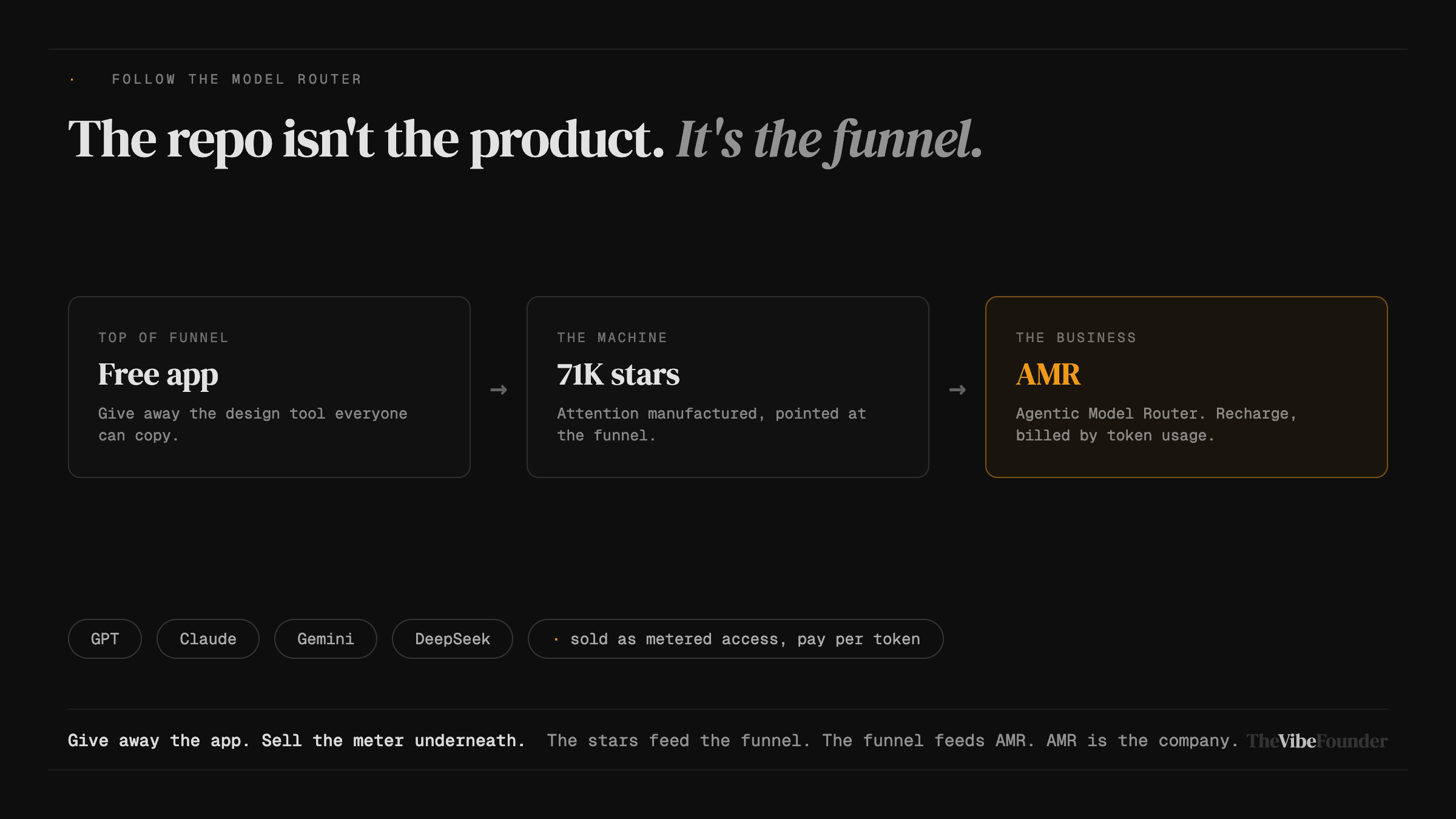
This is an old playbook in new clothes. Give away the thing everyone can copy. Sell the thing they have to keep paying for. The stars feed the funnel. The funnel feeds AMR. AMR is the company.
So when someone shows you the star count, they are showing you the marketing. The business is one layer down, and nobody covering this has told you what it earns.
What Nobody Has Verified
There is one more gap, and it is the biggest.
No one has confirmed the thing produces work you could actually ship.
The research I worked from did not include a hands-on test, and neither did the coverage I have seen. What is visible is a product moving fast enough to be rough. There are 439 open issues. There are documented runs where a single turn blew past 1.4 million tokens. One release shipped tagged, literally, “DO NOT USE.”
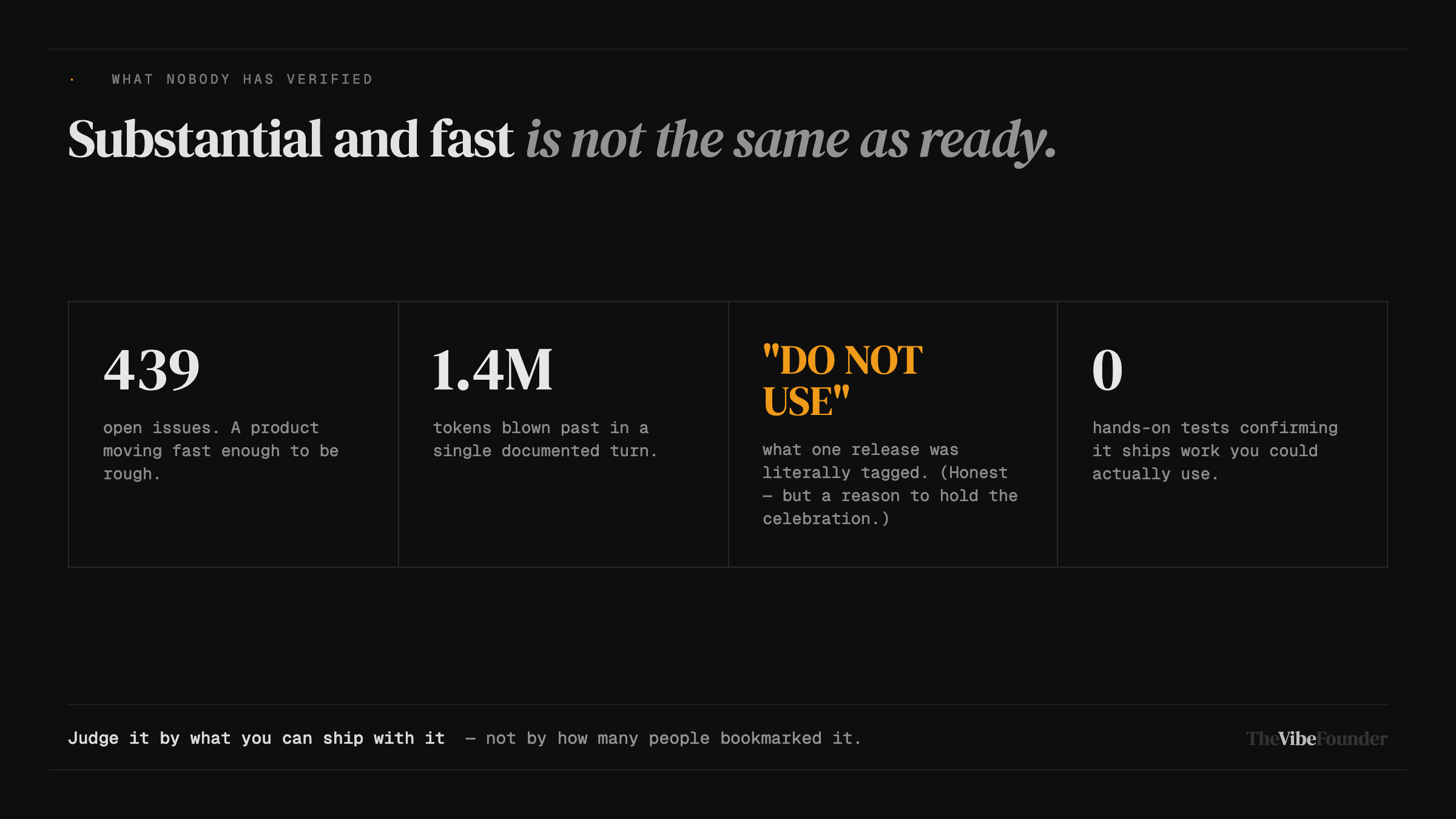
That is not a reason to dismiss it. Shipping that fast and saying “do not use this one” out loud is more honest than most launches. It is a reason to hold the celebration. Substantial and fast is not the same as ready.
The Lesson Isn’t the Tool
Strip away the design app, and what is left is a playbook worth more than the product.
When a big lab ships a viral closed product, it just did your market research for free. It proved demand, on its budget, in public. The opening it leaves is narrow and it closes fast: ship the version the lab cannot, open and local and yours, before the moment passes. Then sell the infrastructure underneath, not the app on top.
nexu did not invent agent-native design. Anthropic did the expensive part. nexu shipped the open answer in weeks and built a meter under it.
Accuracy compounds. Hype decays. The stars are hype. The model router is the business.
What to Actually Watch
This pattern will repeat with every viral closed AI launch this year. The closed product proves the category. The open clone races out within weeks. The winner is rarely the one with the most stars. It is the one who saw the playbook and built the meter.
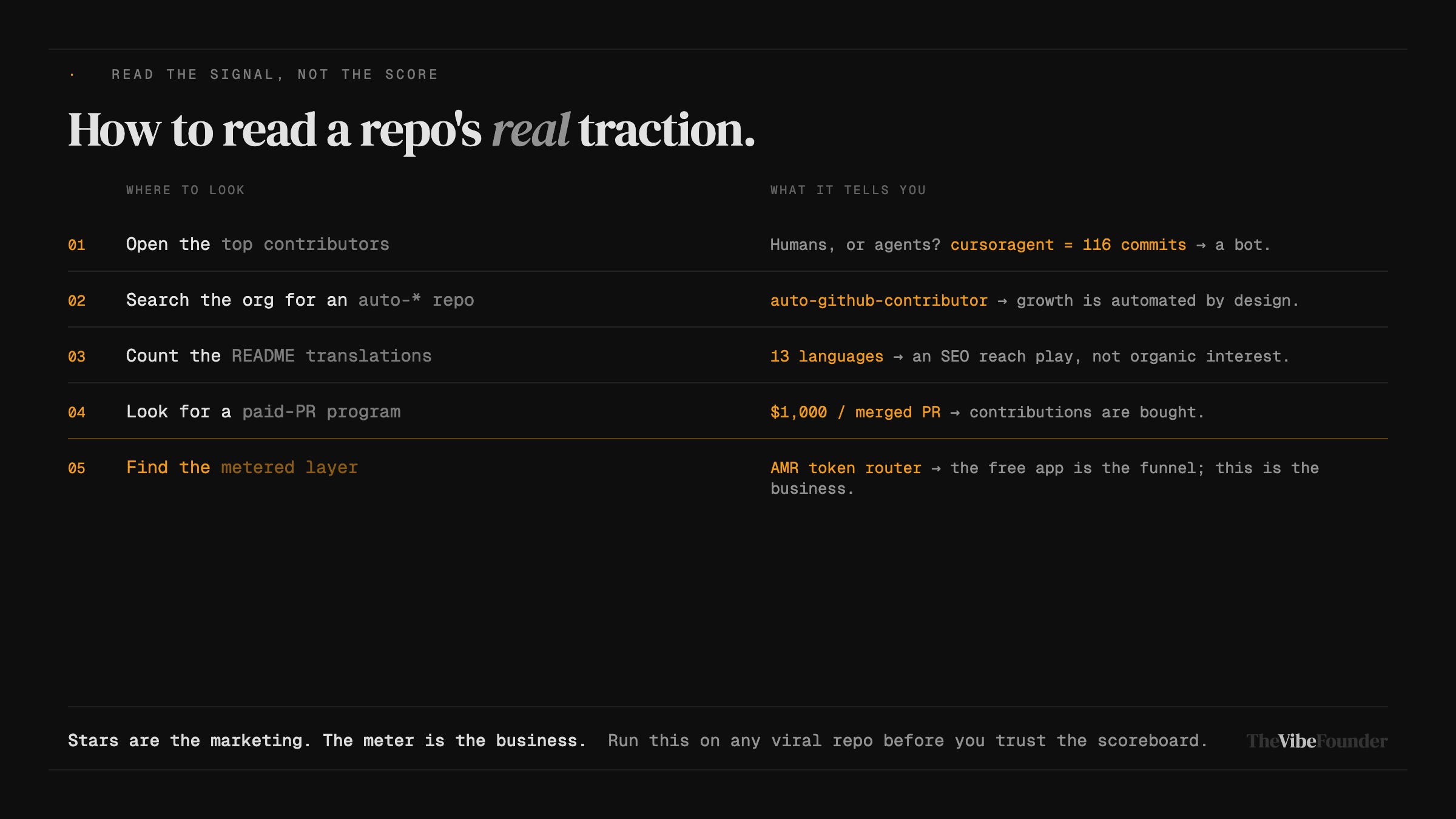
So watch the number that is hard to see, not the one painted on the README. Not 71,000 stars. Whatever AMR is quietly earning per token while everyone argues about a clone.
And if you want to use Open Design yourself, install it. Just judge it by what you can ship with it, not by how many people bookmarked it.
If you’re using Claude Design, would you switch to an open, local version like this? Tell me why, or why not. And if you’ve built something real with either one, I want to see it.
— Aj, @thevibefounder